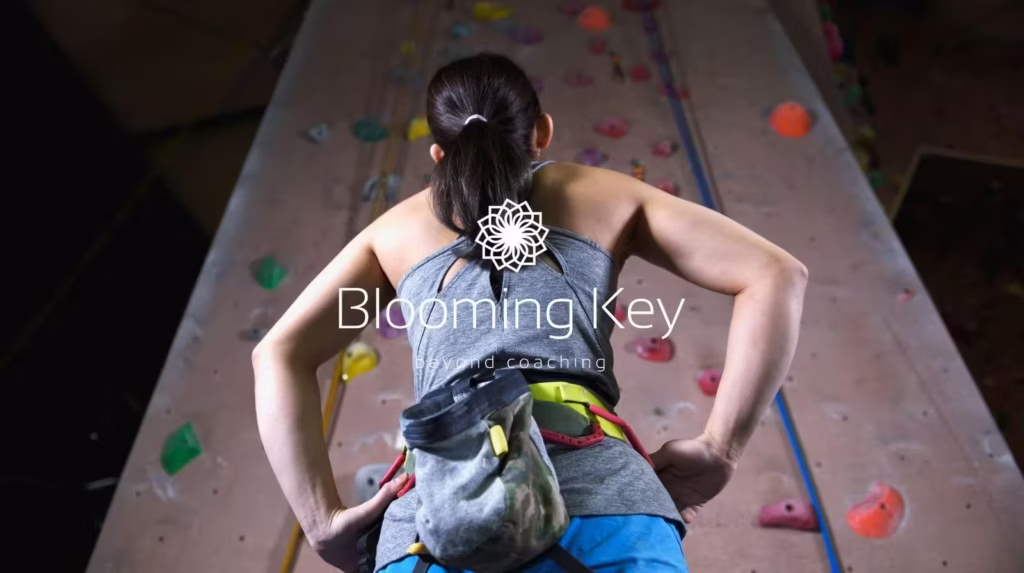
Building self-confidence through mental fitness and emotional resilience

The Skill of Standing Tall

We often treat self-confidence like a personality trait — something people are simply born with, like blue eyes or natural talent. We see confident leaders in Dubai boardrooms and assume they were “wired” that way.

In reality, self-confidence is not a gift — it is a skill. It is built through learning, practice, and the willingness to face discomfort.

If you are navigating high expectations, pressure, and self-doubt, this article will show you how confidence grows through action — not perfection.

Moving Beyond the “Natural Talent” Myth

In performance-driven environments like Dubai and Abu Dhabi, we are conditioned to value polished results and instant expertise.

We rarely see the awkward learning phase behind success. As a result, many professionals wait for certainty before acting — which often leads to stagnation.

Research from Harvard Business Review shows that self-awareness and skill development — not innate talent — are key predictors of long-term confidence.

If you feel like you are “faking it,” you are not lacking ability. You are simply in the middle of growth.

Confidence as Mental Fitness

Confidence works like physical strength. You don’t build it by thinking about it — you build it through resistance.

This is where Mental Fitness Coaching becomes essential. Mental fitness helps you develop emotional stability, self-trust, and clarity under pressure.

True confidence is earned through experience, not affirmations.

1. Build Competence Through Practice

Confidence stands on competence. You feel secure because you understand what you are doing.

Just like learning to drive or manage a team, confidence grows through repetition.

2. Learn to Face “Cringe Moments”

The discomfort you feel when trying something new is not failure — it is expansion.

Public speaking, leading meetings, or expressing boundaries all stretch your comfort zone.

3. Take Small, Decisive Actions

Overthinking weakens confidence. Small actions strengthen it.

Instead of analysing every possible outcome, choose one practical step and move forward.

Courage Is the Real Currency of Confidence

Confidence is not the absence of fear. It is the ability to act while fear is present.

Psychologists at the American Psychological Association describe courage and resilience as core traits of emotional strength.

Every time you navigate a difficult conversation, try something new, or set a boundary, you strengthen your internal authority.

Practical Ways to Strengthen Your Confidence Daily

  • Choose progress over perfection: imperfect action builds momentum.
  • Track small wins: evidence creates belief.
  • Develop emotional regulation: see Anxiety Management tools.
  • Seek structured support: explore Online Coaching.

Confidence grows when your nervous system, skills, and values are aligned.

From Self-Doubt to Self-Trust

You do not have to wait for “the feeling” before you act.

Each courageous step builds evidence that you can trust yourself.

If you are ready to strengthen your confidence and emotional resilience, I invite you to explore a personalised approach.

Contact me here to begin.


Related posts

Stuck in Your Career? Address Childhood Traumas With Life Coaching!

Introduction In today’s high-pressure corporate environment, your career is more than just a list of qualifications. Professional success is intricately linked with emotional well-being, which can often be traced back to formative experiences in our childhood. Believe it or not, ‘small’ childhood traumas can be pivotal in shaping your adult professional life. As a bio-energetic mental fitness life coach with a holistic approach, I’ve seen firsthand how addressing these hidden issues with life coaching can unlock avenues for career growth and personal happiness. Understanding ‘Small’ Childhood Traumas We all carry emotional baggage from our early years. These traumas may not necessarily be glaring instances of neglect or abuse. Even seemingly ‘small’ traumas—like emotional neglect, persistent teasing, or overwhelming parental expectations—can profoundly impact our mental health and, by extension, our career performance. How ‘Small’ Childhood Traumas Affect Your Career 1. Leadership Skills Poor self-esteem stemming from childhood experiences could manifest as hesitancy in leadership roles. Leadership isn’t about domineering control but inspiring trust and collaboration. A compromised sense of self can cripple these essential leadership qualities. 2. Decision-Making The echoes of childhood often linger in our adult decision-making. Career coaching can help spotlight these issues, allowing you to navigate professional choices with increased clarity and balanced judgment. 3. Team Relationships Forming effective teams requires trust, something that may be scarce if you’ve faced ‘small’ childhood traumas like emotional neglect. These past experiences could create invisible barriers to effective communication and collaboration. 4. Performance Anxiety This is a widespread issue in high-stakes

Read More
mental fitness in uncertain times

WHEN THE WORLD FEELS UNSAFE — AND YOUR BODY WON’T SWITCH OFF

When the World Feels Unsafe — and Your Body Won’t Switch Off You wake up, check your phone, and before the day even begins — your body is already tense. Nothing has happened to you directly. And yet, something feels off. If you want to stay mentally steady in uncertain times, this is where the work begins. Not in the news. Not in the analysis. In the body. Your nervous system responds more to perceived threat than to rational geography. You can be sitting in a café in Downtown Dubai, completely safe — and your system is quietly preparing for something happening thousands of kilometres away. This is not a personal failure. Your system is doing exactly what it was designed to do — just in the wrong context. Why Your Body Reacts to War and Global Crisis Your nervous system was not designed for news cycles. It was built for immediate, local threats — something you could see, run from, or fight. War, crisis, and geopolitical instability activate the same ancient system. But here is the problem: There is nothing to run from. Nothing to fight. Nothing to resolve by tonight. So the body stays switched on. Quietly. Constantly. When threat signals come in — headlines, images, conversations — the amygdala activates, cortisol rises, and the body prepares for action that never happens. Repeated activation without resolution creates what Bruce McEwen described as allostatic load — the accumulated wear and tear of chronic stress on the system. You can

Read More
Stress management coach in Dubai helps with burnout

Mental Fitness in the New “Normal”: How to Stay Regulated in Dubai and Abu Dhabi

When the Mind Adapts But the Body Does Not One day, you were stuck in Sheikh Zayed Road traffic, wishing it would just move. The next, you were watching people pack their lives into suitcases, quietly wishing the traffic back. That is how fast the baseline shifted in Dubai. Drones overhead. Sirens at night. Conversations with your partner you never thought you would have — do we stay, do we go, do we send the kids ahead? You scrolled the news at 2 a.m. You checked flight prices “just in case.” You tried to keep working. You tried to keep parenting. You tried to stay calm. And somewhere underneath all of it, the pressure quietly grew. There are moments of quiet now. But nothing feels fully settled. And your body knows it. This is the new “normal.” And this is exactly where mental fitness becomes relevant. If you want to understand how this works in practice, you can explore my approach to mental fitness coaching in Dubai and Abu Dhabi. When the Mind Adapts But the Body Does Not The mind is designed to adapt quickly. It gets used to uncertainty. It normalizes pressure. It keeps you functional. But your nervous system does not work like that. It does not respond to logic. It responds to accumulated load. You may have stopped reacting emotionally to the news. You may feel more composed. That does not mean your system has recovered. Often, it means the response has moved inward — into

Read More
personal growth supported by community and emotional connection

Why Growth Rarely Happens Alone

The quiet isolation of capable people Many of the people I work with are highly independent. They’ve learned to rely on themselves. To think clearly. To carry responsibility. To be the one who holds things together — at work, in families, and in complex environments. And yet, underneath that competence, there is often a quiet sense of doing everything alone. Not lonely in the obvious way.Lonely in the functional way. You can be surrounded by people and still feel unseen internally. Especially when you are the capable one. The calm one. The one who doesn’t need much. Many professionals who explore life coaching and personal transformation describe exactly this experience — a life that looks successful on the outside but feels heavier internally than expected. If this resonates, you may also find clarity in When Life Looks Good But Feels Heavy, where we explore why high performers often carry silent internal pressure. Why growth accelerates in the right environment Community in personal growth is often misunderstood. It’s not about dependency.It’s not about sharing everything or leaning outward all the time. It’s about not holding your inner experience in isolation. Growth accelerates when something inside you no longer has to stay contained. When you are witnessed without being analysed. Supported without being fixed. For many clients exploring life transformation coaching, the shift begins not with a technique, but with the moment their nervous system finally feels safe enough to soften. Why high performers carry invisible pressure This is especially true for

Read More