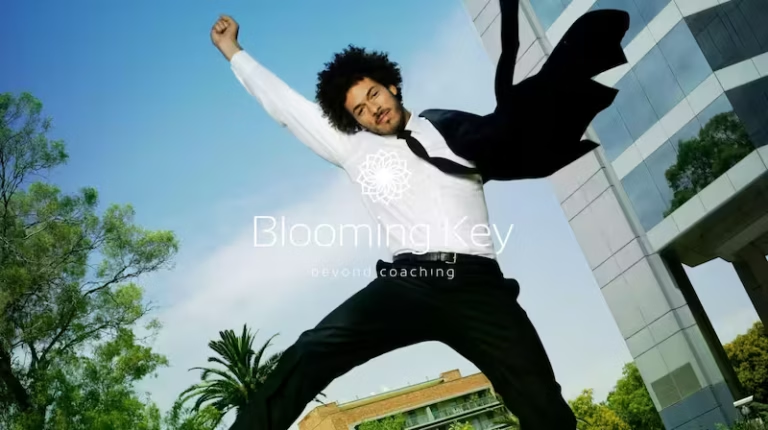

4 Tips for Looking and Feeling More Confident

4 Tips for Looking and Feeling More Confident

Are you looking for ways of looking and feeling more confident? Have you ever been in a situation where you needed to be confident but you just were not feeling it? Being confident is important but sometimes it can be hard to come by. While some people may have confidence that lasts, for the rest of us the feeling is not a constant. When we are with people we know well, it is easy to be confident, but when we are in a new situation or with strangers, it can take some time before we feel self-assured.

So what is the secret to believing in yourself? You simply have to seem or look confident to others around you. A major part of confidence involves how you look and appear, rather than how you feel. Confidence is a learned skill that can be built with adequate practice.

Here are a few simple ways to increase your self-confidence:

1. Keep a Good Posture

Good posture is the foundation of looking confident. If you are sitting, make sure your back is straight, but not rigid. Sit up tall and keep your chin up. If you are standing, keep your weight balanced on both feet, your shoulders square and relaxed. This friendly, open postures make others feel comfortable around you.

2. Maintain Eye Contact

Eye contact is essential for projecting confidence. Look people in the eye whether you are talking to one person or you are addressing a group. Your gaze should be strong enough to indicate that you are paying attention without appearing aggressive or intimidating.

3. Speak Slow and Clear

When we are nervous or unsure of ourselves we tend to speak faster than usual. This can not only signal to others that you feel insecure but it can seriously harm the points that you are trying to get across to another person. Slowing down the way you talk and making pauses where it is appropriate will make a huge difference during such situations.

4. Smile at People

Putting on a smile can help you feel happier and more confident on the inside as well as help to make others see you as more approachable and competent. Smiling is also said to release endorphins and reduce stress levels.

Building your confidence levels helps to make you a more magnetic and pleasant person no matter where you go. Other people are drawn to confidence, and you will automatically be assumed as a capable person.

Related posts

Stuck in Your Career? Address Childhood Traumas With Life Coaching!

Introduction In today’s high-pressure corporate environment, your career is more than just a list of qualifications. Professional success is intricately linked with emotional well-being, which can often be traced back to formative experiences in our childhood. Believe it or not, ‘small’ childhood traumas can be pivotal in shaping your adult professional life. As a bio-energetic mental fitness life coach with a holistic approach, I’ve seen firsthand how addressing these hidden issues with life coaching can unlock avenues for career growth and personal happiness. Understanding ‘Small’ Childhood Traumas We all carry emotional baggage from our early years. These traumas may not necessarily be glaring instances of neglect or abuse. Even seemingly ‘small’ traumas—like emotional neglect, persistent teasing, or overwhelming parental expectations—can profoundly impact our mental health and, by extension, our career performance. How ‘Small’ Childhood Traumas Affect Your Career 1. Leadership Skills Poor self-esteem stemming from childhood experiences could manifest as hesitancy in leadership roles. Leadership isn’t about domineering control but inspiring trust and collaboration. A compromised sense of self can cripple these essential leadership qualities. 2. Decision-Making The echoes of childhood often linger in our adult decision-making. Career coaching can help spotlight these issues, allowing you to navigate professional choices with increased clarity and balanced judgment. 3. Team Relationships Forming effective teams requires trust, something that may be scarce if you’ve faced ‘small’ childhood traumas like emotional neglect. These past experiences could create invisible barriers to effective communication and collaboration. 4. Performance Anxiety This is a widespread issue in high-stakes

Read More
personal growth supported by community and emotional connection

Why Growth Rarely Happens Alone

The quiet isolation of capable people Many of the people I work with are highly independent. They’ve learned to rely on themselves. To think clearly. To carry responsibility. To be the one who holds things together — at work, in families, and in complex environments. And yet, underneath that competence, there is often a quiet sense of doing everything alone. Not lonely in the obvious way.Lonely in the functional way. You can be surrounded by people and still feel unseen internally. Especially when you are the capable one. The calm one. The one who doesn’t need much. Many professionals who explore life coaching and personal transformation describe exactly this experience — a life that looks successful on the outside but feels heavier internally than expected. If this resonates, you may also find clarity in When Life Looks Good But Feels Heavy, where we explore why high performers often carry silent internal pressure. Why growth accelerates in the right environment Community in personal growth is often misunderstood. It’s not about dependency.It’s not about sharing everything or leaning outward all the time. It’s about not holding your inner experience in isolation. Growth accelerates when something inside you no longer has to stay contained. When you are witnessed without being analysed. Supported without being fixed. For many clients exploring life transformation coaching, the shift begins not with a technique, but with the moment their nervous system finally feels safe enough to soften. Why high performers carry invisible pressure This is especially true for

Read More
Person reflecting by a window — when life looks good but feels heavy

When Life Looks Good But Feels Heavy

When Life Looks Good But Feels Heavy — And You Can’t Explain Why When life looks good but feels heavy, most people don’t talk about it. They carry it quietly. Especially high achievers in fast-moving cities like Dubai, where performance is expected and internal struggles are rarely visible. They show up. They deliver. They succeed. And somewhere between the morning coffee and the evening routine, they wonder why none of it feels the way it should. If that sounds familiar, this is for you. Not to fix anything. Just to name what’s happening — and to explain why the weight you’re carrying is not a flaw. It’s a signal. This is one of the most common themes I see in my coaching room in Dubai. Someone accomplished and composed sits down and says, “I don’t know what’s wrong with me. My life is good. I should be happy.” That word — should — tells me everything. The Gap No One Talks About There’s a specific kind of exhaustion that comes from living a life that looks right but doesn’t feel right. It’s not clinical depression. It’s not obvious burnout. It’s subtler than that. And that subtlety makes it confusing. You’re still functioning. Still producing. Still holding everything together. But inside, there’s a flatness. A quiet tension that doesn’t disappear — even on weekends or holidays. You might notice irritability. Or emotional distance. Or lying awake at 11pm searching “why do I feel empty despite success” — then closing the tab

Read More
When Anxiety Finally Let Go | A Quiet Shift (Dubai/UAE)

 When the Anxiety Finally Let Go

There are moments in my work that stay with me. Not because they are dramatic, but because they are true. When Anxiety Becomes a Background Noise I’m thinking of a client who carried anxiety for decades. The kind that hides well. No visible panic. No breakdowns. Just a constant internal tension — like a system that never fully powered down. He functioned extremely well. Career, responsibilities, composure. From the outside, nothing looked wrong. And for a long time, even he thought this was simply “how life feels.” What Changed Was Not Force We didn’t try to remove the anxiety. We worked gently, layer by layer. Sometimes we touched beliefs. Sometimes old emotional charge. Sometimes we did very little, except create enough internal safety for his system to soften. After almost every session, he said the same thing: “I feel lighter.” Not cured. Not done. Just lighter. For a while, the anxiety stayed — but it changed. It had less grip. Less authority. It stopped running in the background all the time. The Quiet Moment It Finally Let Go And then one day, he arrived and paused for a moment before speaking. “I just realised… it’s gone.” No big emotion. No relief explosion. Just a quiet noticing. As if a sound had stopped hours ago, and only now he became aware of the silence. What Followed Was the Real Shift What moved me most wasn’t that the anxiety disappeared. It was what followed. Ease. Presence. A sense of being grounded in

Read More